Bookkeeping basics
20 questions to ask your books, and how often to ask them
Each question comes with how often to ask it and the report that answers it.
The short answer
Check your cash every week and your profit every month. The 20 questions below cover both, plus a few for each quarter and year end, and most of them are answered by a standard report your accounting software already has.
On this page
What should I ask my books, and how often?
Ask your books about cash every week and profit every month. Direction waits for the quarter, and the full picture for the year. Thirteen of the 20 questions below are weekly or monthly checks on cash and profit.
| How often | What you’re checking | Number of questions | Main reports |
|---|---|---|---|
| Weekly | Cash, who owes you and which bills are due | 6 | Balance Sheet cash lines, A/R and A/P aging, bank feed |
| Monthly | Profit, once the month is reconciled | 7 | Profit and Loss, Balance Sheet, reconciliation history |
| Quarterly | Customers, products, sales tax and budget | 4 | Sales by Customer, Sales by Product or Service, Budget vs. Actuals |
| Yearly | Full-year numbers for your tax preparer and lender | 3 | Profit and Loss for the year, Balance Sheet, 1099 summary |
Here are all 20, each with the report that usually answers it. The report names are the common ones. Your software may use a different name, like “Income Statement” for the Profit and Loss.
| # | Question | How often | Where to find the answer |
|---|---|---|---|
| 1 | How much cash do I have today? | Weekly | Balance Sheet (cash accounts) or bank register |
| 2 | Who owes me money, and who is late? | Weekly | A/R Aging Summary |
| 3 | What bills are due in the next two weeks? | Weekly | A/P Aging or Unpaid Bills |
| 4 | Will I have enough cash for the next payroll? | Weekly | Cash flow forecast, or both aging reports |
| 5 | Which bank transactions still need a category? | Weekly | Bank feed review list |
| 6 | What new recurring charges showed up? | Weekly | Expenses by Vendor |
| 7 | Did I make money last month? | Monthly | Profit and Loss |
| 8 | What changed from the month before? | Monthly | Profit and Loss with a prior-month column |
| 9 | What is my gross margin? | Monthly | Profit and Loss |
| 10 | Where is my money going? | Monthly | Expenses by Vendor |
| 11 | How many months of cash do I have? | Monthly | Balance Sheet plus Profit and Loss |
| 12 | Are my bank and card accounts reconciled? | Monthly | Reconciliation history |
| 13 | How much have I paid myself? | Monthly | Balance Sheet (owner’s equity), plus payroll if you take wages |
| 14 | Who are my biggest customers? | Quarterly | Sales by Customer |
| 15 | Which products or services bring in the most? | Quarterly | Sales by Product or Service |
| 16 | How much sales tax do I owe? | Quarterly | Sales Tax Liability |
| 17 | Am I on budget? | Quarterly | Budget vs. Actuals |
| 18 | What did the business earn this year? | Yearly | Profit and Loss for the fiscal year |
| 19 | What is the business worth on paper? | Yearly | Balance Sheet |
| 20 | Which contractors did I pay, and how much? | Yearly | Contractor (1099) summary or Expenses by Vendor |
The weekly questions are quick once your bank feed is current. The monthly ones need the month reconciled first. Otherwise you’re reading numbers that will still move.
What should I check every week?
Cash. In the Federal Reserve Banks’ 2026 report on employer firms, 54% of small employers named paying operating expenses as a financial challenge in the past year. Half named uneven cash flow, which the survey says includes collecting from customers. The weekly questions show you a tight week before it arrives.
1. How much cash do I have today?
Look at the cash lines on your Balance Sheet, or the balance in your bank register, and make sure it matches what the bank shows.
2. Who owes me money, and who is late?
An invoice gets harder to collect every week it sits. The A/R Aging Summary sorts what customers owe you by how many days past due it is. Call about anything in the 30-day column before it reaches 60.
3. What bills are due in the next two weeks?
Knowing what’s coming lets you pay on time without overdrawing. The A/P Aging report, or unpaid bills sorted by due date, shows it.
4. Will I have enough cash for the next payroll?
Payroll is a payment you can’t be late on. A cash flow forecast starts with today’s cash, adds what customers should pay you and subtracts the bills and payroll coming up. If your software has no forecast, the two aging reports give you most of the pieces.
5. Which bank transactions still need a category?
An uncategorized charge can throw off every number on this list. Clear the review list in your bank feed each week and it stays short.
6. What new recurring charges showed up?
A forgotten subscription is an easy leak to miss. Scan Expenses by Vendor for names you don’t recognize, or a monthly charge that went up.
What should I check every month?
Profit, and whether it turned into cash. Do these once the month is reconciled, usually in the first week or two of the next month.
7. Did I make money last month?
Your accountant and any lender will want this number. The Profit and Loss subtracts what you spent from what you sold, for the month.
8. What changed from the month before?
A swing you can explain is fine. A swing you can’t is a warning. Run the Profit and Loss with a column for the prior month, or the same month last year if your sales are seasonal. Then look at the biggest differences first.
9. What is my gross margin?
Gross profit is sales minus what the goods or the work cost you, before rent and other overhead. Gross margin is that profit as a share of sales. Divide gross profit by sales, both on the Profit and Loss. It tells you whether your prices cover your costs.
10. Where is my money going?
Start with your five biggest vendors. A saving there is worth the most. Expenses by Vendor puts them at the top.
11. How many months of cash do I have?
This is runway: how long you could keep going if sales stopped. Take the cash on your Balance Sheet and divide it by what you spend in an average month. Your Profit and Loss shows that spend. A 2016 JPMorgan Chase Institute study found the median small business held about 27 days of cash. A quarter held fewer than 13 days.
12. Are my bank and card accounts reconciled?
Reconciling checks your books against the bank statement, line by line. An account that isn’t reconciled can hide a missed deposit or a double charge. Check the statement date of the last finished reconciliation on each account.
13. How much have I paid myself?
Owner draws come out of your cash but don’t show up on the Profit and Loss. Look at the owner’s equity section of the Balance Sheet, or the history of your Owner’s Draw account. If you also pay yourself wages through payroll, those are on the Profit and Loss, so add the two.
What should I check every quarter?
Every quarter, check the numbers that show where the business is heading: how much of your sales come from one customer, which products sell best, the sales tax you owe and how you’re doing against your budget. They change too slowly to check every week.
14. Who are my biggest customers?
If one customer is 40% of your sales, losing them is a crisis. Sales by Customer shows how your revenue is spread, so you see the risk before it shows up.
15. Which products or services bring in the most?
Sales by Product or Service ranks them, so you know what to sell more of.
16. How much sales tax do I owe?
Sales tax is the government’s money sitting in your account. If you collect it, check the Sales Tax Liability report before each filing, whatever your schedule is. Know the number and hand it to whoever files for you.
17. Am I on budget?
A budget only helps if you check it while there’s time to change course. Budget vs. Actuals puts the plan and what happened side by side. If you’ve never made a budget, last year’s Profit and Loss is a fine place to start one.
What should I check every year?
Every year, pull what your tax preparer and your lender ask for. That means the full year’s Profit and Loss on the basis you file on, the year-end Balance Sheet, and the list of contractors you paid.
18. What did the business earn this year?
Run the Profit and Loss for the full fiscal year, on the basis you file on. Cash basis counts money when it moves. Accrual basis counts sales when you earn them, usually when you invoice, and costs when you take them on. IRS Publication 583 draws the same line for taxes: income when you receive it under the cash method, and generally when you earn it under an accrual method. The two can show different profits for the same year, so make sure your preparer gets the right one.
19. What is the business worth on paper?
The Balance Sheet lists what the business owns, what it owes and what’s left over for you. Lenders and buyers will ask for it.
20. Which contractors did I pay, and how much?
Year-end contractor forms depend on this list. Run the contractor or 1099 summary if your software has one, or Expenses by Vendor, and give it to your preparer.
What can’t your books tell you?
How much to set aside for income tax. Your books give your preparer the profit and the draws, and the preparer makes that call. Your books also can’t tell you how you compare to businesses like yours. That takes outside data, like an industry survey.
And these 20 answers are only as good as the books behind them. If keeping them current is the part you never get to, see what a bookkeeper costs.
Can I ask my books these questions with AI?
Yes. You type the question the way you’d say it, instead of finding the right report and reading it.
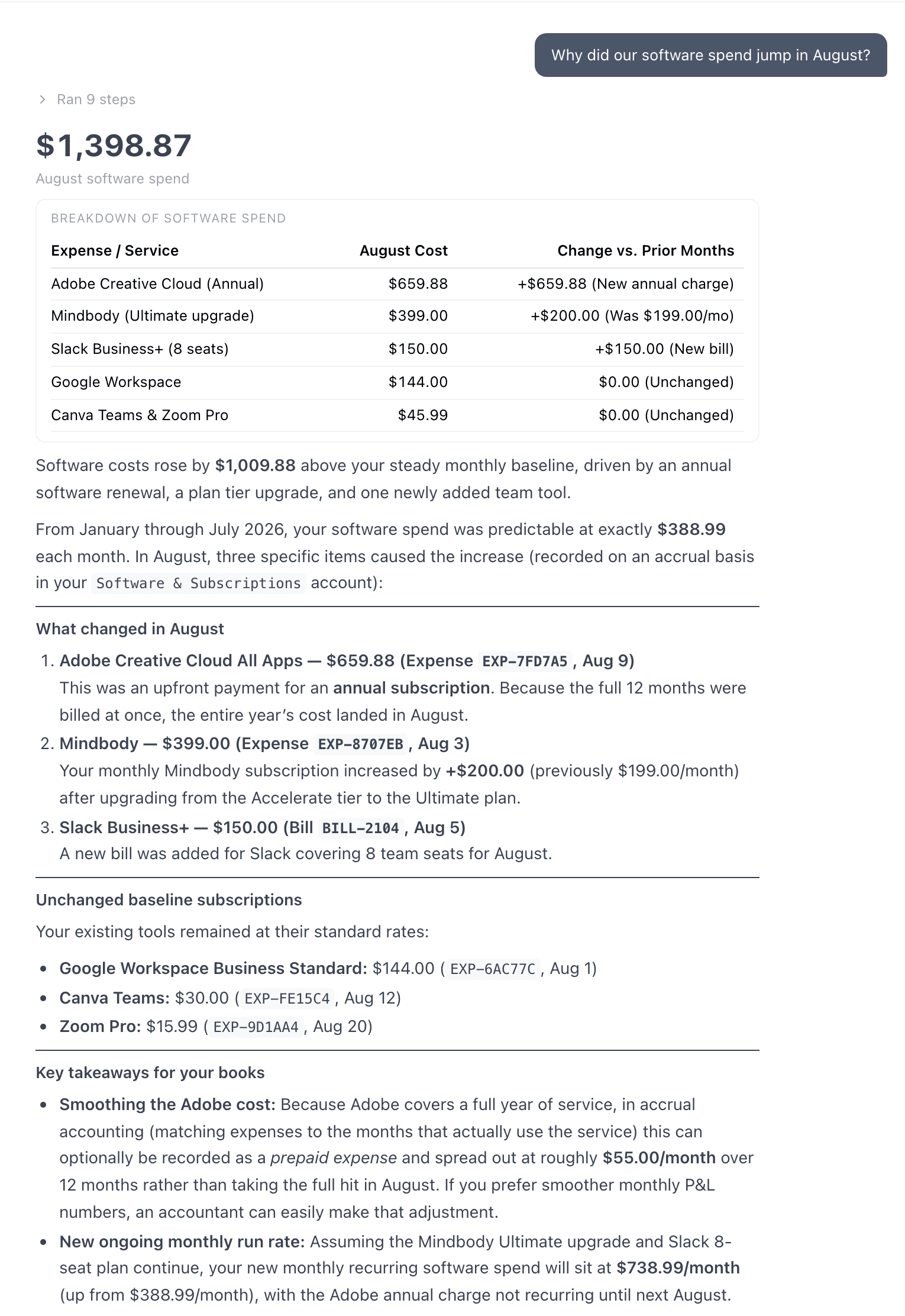
What the AI can see matters. A chatbot connected to your bank account can tell you where your money went. Who owes you and what you owe live in your books, in the invoices and bills you’ve entered, so the AI needs to read the books to answer those. More accounting software now has AI that does. Here’s more on what AI accounting software does.
In Imprest, the feature is called Ask. It reads your ledger and runs the same reports as the Reports screen, so its answer ties to the report. It says whether an income or expense figure is on a cash or accrual basis, and it names the accounts and transactions it used. If nothing in your books covers the question, it says so. Any change it suggests waits for you.
Frequently asked questions
How often should I review my business finances?
Look at cash every week, including who owes you and which bills are coming due. Look at profit every month, once the bank accounts are reconciled. Step back once a quarter for customers and budget, and once a year for the full-year numbers your tax preparer needs.
What financial reports should I review every month?
The Profit and Loss, the Balance Sheet, the Statement of Cash Flows and Expenses by Vendor. Read the Profit and Loss next to the month before it, so you see what changed. The A/R Aging Summary is worth a look every week.
What is the most important number for a small business owner?
Cash, and how long it will last. A business can show a profit and still run short, because accrual profit counts sales you haven’t collected yet, and owner draws take cash out without lowering profit.
Can my books tell me how much to set aside for taxes?
They give your tax preparer the numbers, like profit for the year, owner draws and contractor payments. How much to set aside is your preparer’s call.
Can AI answer questions about my business finances?
Yes. AI connected to your bank feed can tell you what you spent and where. AI that reads your full books can also tell you who owes you and what you owe, and a good one points you to the report behind the answer.
Sources
- Federal Reserve Banks, Small Business Credit Survey, “2026 Report on Employer Firms,” March 3, 2026, checked October 31, 2026
- JPMorgan Chase Institute, “Cash is King: Flows, Balances, and Buffer Days,” September 2016, checked October 31, 2026
- IRS, Publication 583 (Rev. December 2024), Starting a Business and Keeping Records, checked October 31, 2026